Warehouse Design Software
for AI-supported warehouse layouts

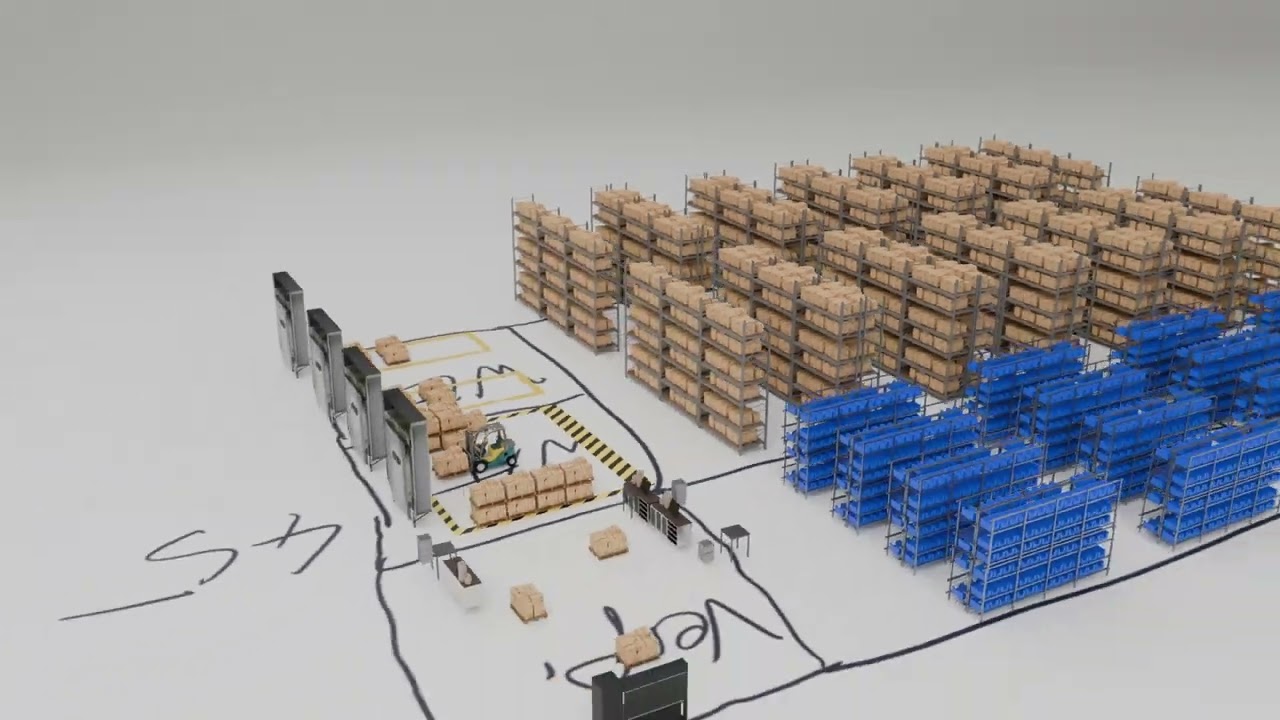
The warehouse design software "WarehouseDesigner" transforms warehouse layout sketches into structured digital layouts. The approach addresses the concept phase of warehouse planning, in which key decisions are often only available as block layouts. AI-based computer vision recognizes functional areas, interprets designations and capacities, and uses this information to generate digital variants.

This reduces manual transfers, shortens project durations, and makes variant comparisons more reliable. Fraunhofer IML is continuing to develop WarehouseDesigner to make warehouse planning data-based, transparent, and scalable.

Auf dem Bild ist eine Tablett zu sehen auf dem eine händisch erstellte Skizze mit dem Warehouse-Designer umgewandelt wird.
© Fraunhofer IML

Limits of traditional warehouse planning

Modern warehouse planning follows a clearly structured process. The analysis of relevant planning data and processes is followed by concept planning. This is followed by detailed planning, tendering, implementation, and operation. This entire process ties up human resources for months or even years.
There are obstacles to an efficient planning process:

  • In the concept phase, there is a poorly structured decision-making problem.
  • The solution depends heavily on the expert knowledge of individual specialists.
  • Many projects only consider a few variants from the possible solution space.
  • Fragmented information in tables, presentations, layout plans, and documents increases the effort required.
  • Conventional methods provide only limited comparability of logistical solutions.

The Fraunhofer Institute for Material Flow and Logistics IML addresses these challenges with WarehouseDesigner as a digital tool for warehouse layout planning.

Get to know the WarehouseDesigner

Brief overview of the approach and application.

  • AI-supported capture of block layout sketches in the system or via photo
  • Automatic generation of digital, rule-compliant warehouse layouts from sketches
  • Use of layout variants as a basis for further warehouse planning software

Learn more about WarehouseDesigner

Warehouse design software in the concept phase of warehouse planning

WarehouseDesigner comes into play in the concept phase, when warehouse layouts often exist only as block layouts on paper or as simple sketches. Sketches are created in the application's canvas or entered into the system as photos. The warehouse design software identifies functional areas, interprets labels and size specifications, and uses this information to generate digital layout variants. 
Warehouse layout software for the concept phase: How it works

  1. Create a sketch or upload a photo
  2. AI analysis: Recognition of areas, labels, and sizes
  3. Structure & rules: Consistent, rule-compliant presentation
  4. Variant creation & optimization: Layout variants based on defined goals (e.g., space efficiency)
  5. Utilizing results: 2D layout + export for follow-up processes

A genetic algorithm places the areas in the building envelope in accordance with regulations, scales them according to capacity or target area, and takes quality criteria such as space efficiency into account. The system displays the layouts in two dimensions, exports them as CAD files, and forms a structured database for future recommender systems.

Auf dem Bild ist eine Tablett zu sehen auf dem eine händisch erstellte Skizze mit dem Warehouse-Designer umgewandelt wird.
© Fraunhofer IML
Draw the warehouse layout on the canvas or upload it as a photo.
Auf dem Bild ist eine Tablett zu sehen auf dem eine händisch erstellte Skizze mit dem Warehouse-Designer umgewandelt wird.
© Fraunhofer IML
Recognition of functional areas through AI
Auf dem Bild ist eine Tablett zu sehen auf dem eine händisch erstellte Skizze mit dem Warehouse-Designer umgewandelt wird.
© Fraunhofer IML
Generation of digital, optimized warehouse layouts

"Our warehouse design software generates optimized, rule-compliant layouts from warehouse layout sketches in seconds, significantly accelerating the concept phase and enabling earlier, well-founded investment decisions."
Alexander Krooß, M. Sc., conducts research on intralogistics at Fraunhofer IML.

Areas of expertise of the warehouse design software WarehouseDesigner

The warehouse design software focuses on AI-supported computer vision and optimization for warehouse layout. The vision pipeline recognizes rectangular functional areas, text regions with handwritten or digital text, and the outer edges of the warehouse. A vision language model transcribes handwriting. Language models extract titles, capacities, and target areas using named entity recognition.

The genetic algorithm dimensions areas, pays attention to areas without overlap, outer wall contact of certain zones, compact arrangement, short path relationships, and small residual areas. Planners use the results as warehouse planners for systematic variant comparisons in the concept phase.

WarehouseDesigner in practice: From block layout to digital warehouse layout

The video shows a complete run through of WarehouseDesigner: Starting with a hand-drawn layout sketch or a photo, the warehouse design software digitizes the warehouse layout, recognizes function-related areas and labels, and uses this information to generate a rule-compliant, structured layout representation.

The resulting digital warehouse layouts serve as a reliable basis for further planning steps, including CAD export and variant comparison.

Privacy warning

With the click on the play button an external video from www.youtube.com is loaded and started. Your data is possible transferred and stored to third party. Do not start the video if you disagree. Find more about the youtube privacy statement under the following link: https://policies.google.com/privacy

Try WarehouseDesigner in your own warehouse

Use WarehouseDesigner to measurably accelerate your concept phase and evaluate more variants instead of just pursuing individual ideas. Using the warehouse design software enables:

  • Automatic capture of layout sketches instead of manual transfer
  • Digital, compliant warehouse layouts as a reliable basis for detailed planning and CAD
  • Systematic comparison of variants with regard to costs, space, and scenarios

Let's shape the next generation of concept planning for warehouse systems together.

Research perspectives for warehouse design software

The further development of the WarehouseDesigner aims at interactive 3D visualization of the generated warehouse layouts. This provides planners with clear variants for customer feedback at an early stage. Future expansion stages will incorporate material flow, conveyor technology, and performance limits into the evaluation.

A curated portfolio of variants will provide alternatives based on different target functions, such as minimum space or low investment costs. In the future, robust geometry recognition will expand the vision pipeline to include irregular structures such as L-shapes or brownfield scenarios. In addition, reinforcement learning approaches offer potential for feeding user feedback back into warehouse layout planning.

FAQ - Warehouse Design Software

  • WarehouseDesigner functions as an AI-supported application for the concept phase. It digitizes warehouse layout sketches, recognizes functional areas with capacities and dimensional entries, and uses them to generate digital warehouse layouts. The vision pipeline maps the sketches in a structured manner. The system creates variants that serve as the basis for detailed warehouse layout planning and further warehouse planning software.

  • The application reads block layout sketches, interprets areas such as goods receipt or pallet storage, and recognizes capacities or target areas. A genetic algorithm dimensions these areas, places them in the building envelope in accordance with regulations, and takes criteria such as space efficiency into account. This results in a digital warehouse layout that serves as the basis for warehouse layout variants, CAD exports, and systematic comparisons.

  • WarehouseDesigner generates a digital warehouse layout from a block layout sketch in a matter of seconds. The AI processes sketches or photos, recognizes functional areas, labels, and sizes, and uses this information to generate layout variants that can be used immediately. This saves planners many manual iterations in warehouse layout or warehouse layout planning and allows them to move on more quickly to downstream steps such as CAD development and variant comparison.

  • The vision pipeline recognizes functional areas with an object detection model. Another model finds text regions with handwritten or digital text. A vision language model transcribes the text. Named entity recognition extracts titles, capacity, and area. The software assigns the information to the areas. This creates a structured basis that a warehouse planner can use for further design.

  • The solution is aimed at specialist planners in intralogistics who create warehouse layout variants in the concept phase. It is aimed at companies that use sketches as a starting point and need digital, compliant warehouse layouts with less manual effort. Research partners also receive a platform for testing AI methods in warehouse planning software in practice.

  • WarehouseDesigner is currently under active development at Fraunhofer IML. The software captures block layout sketches, generates digital warehouse layouts, and exports them as CAD files. In the future, 3D visualization and the integration of material flow analyses are planned in order to make warehouse layout planning more data-driven.

  • The layouts generated are visualized in two dimensions and are available as CAD exports.