 Fraunhofer Institute for Material Flow and Logistics IML
The Digital Testbed Air Cargo (DTAC) is a cross-location, neutral and practice-oriented research and test field for air cargo logistics. Stakeholders in the air cargo transport chain collaborate to develop, validate and demonstrate digital applications, standards and technologies at several German airports. The focus is on standardized data exchange, automation and AI. Results include NE:ONE®, digital accompanying documents, a Smart Pouch, forecasting models, an AI dashboard, robotics developments and tests, and a digital avatar.
Air Cargo Logistics at DTAC - Digital Testbed Air Cargo
Privacy warning
With the click on the play button an external video from www.youtube.com is loaded and started. Your data is possible transferred and stored to third party. Do not start the video if you disagree. Find more about the youtube privacy statement under the following link: https://policies.google.com/privacyProject objective and challenges in air cargo
The project establishes a joint development and testing environment for digital applications, standards and technologies in air cargo logistics. It brings together three areas of expertise:
- Standardized data exchange between the private sector and government agencies
- Automation and autonomization of dispatch, handling and transport processes
- AI-supported optimization and forecasting applications
The project thus addresses the challenges posed by the large number of stakeholders involved, heterogeneous systems, complex coordination processes and, in some cases, fluctuating data sets. With its neutral, location-independent research approach, it accelerates the introduction of “ONE Record,” collaboratively addresses technical, organizational and procedural issues and strengthens Germany’s position as a global air cargo hub. Close collaboration with operational partners is essential for defining requirements, conducting tests and evaluating real-world performance.
Digitalization in air cargo – comprehensive guidance at every stage
During the ongoing digital transformation of the air freight industry, the initiative provides guidance at every stage - with a clear strategy, technical expertise and practical implementation.
- Integrating new technologies into air cargo processes
- “ONE Record” / NE:ONE® implementation support
- Automation potential analyses for operations
- Rollout support for autonomous systems and vehicles, and corresponding control centers (airside and landside)
- On-site demonstrations of our proprietary systems at your campus
- Presentations and workshops at internal and external events
Project overview
| Project Title | Digital Testbed Air Cargo (DTAC) |
|---|---|
| Brief Profile | A cross-site, neutral and practical research and test bed for digital applications in air cargo |
| Start | September 15, 2021 |
| Duration | Phase 1: September 1, 2021 to September 1, 2024; Continuation starting in September 1, 2024; Module I was additionally extended through December 31, 2026, at no additonal cost |
| Structure | First phase with six work streams Continuation starting in September 2024 with three in-depth work streams |
| Topic Areas | Standardized data exchange; automation and autonomy; AI-supported optimization and forecasting |
| Locations | Frankfurt, Cologne, Leipzig, Munich (Düsseldorf*) (Stuttgart*) (Hamburg*) * 2021-2024 |
| pARTNERs | Fraunhofer IML Frankfurt University of Applied Sciences Fraport AG Cargogate Munich Airport GmbH Mitteldeutsche Airport Holding Sovereign Speed GmbH Schenker Deutschland AG Lufthansa Cargo AG CHI Deutschland Cargo Handling GmbH Cologne/Bonn Airport GmbH LUG aircargo handling GmbH (associated) CHAMP Cargosystems GmbH (associated) |
| management | Fraunhofer IML |
| FUnding | 18 million euros total funding |
| wEBSITE | Digitales Testfeld Air Cargo | DTAC |
“By leveraging artificial intelligence, fully digitized processes and new standards such as “ONE Record,” organizations can make effective use of limited infrastructure and an increasingly scarce workforce while enhancing operational efficiency.”
Dr. Harald Sieke, Head of the Aviation Logistics Department at the Fraunhofer Institute for Material Flow and Logistics IML and Head of the DTAC Project.
The solution: digital infrastructure for air cargo logistics
The DTAC’s solutions combine open standards, open source, simulation, AI and automation within a common testing framework. The consortium developed and validated the applications in close collaboration with operational partners to ensure that requirements, testing and practical evaluation were aligned from the outset.
In the area of data exchange, the project further developed and implemented NE:ONE®, an open-source software, to make “ONE Record” practically usable in decentralized test and application environments. In addition, the project developed an accompanying NE:ONE® ecosystem with further “ONE Record”-native applications.
At the same time, the project expanded the Digital Avatar to provide an end-to-end representation of the air cargo chain and integrated it with AI prediction. In the area of AI, the project established forecasting, compliance and visualization solutions. The project successfully tested automation and autonomous apron transport as well as robotics-based warehouse and hangar processes. The project published open-source-compatible results through the Open Logistics Foundation. The work streams, which have been ongoing since fall 2024, are focusing their results on standardization, further demonstrations, field tests and production-ready implementations.
Data exchange with “ONE Record”, NE:ONE® and digital applications
Through the DTAC project, Fraunhofer IML, together with its project partners, is driving forward the digitization of data exchange in air cargo based on the IATA “ONE Record” standard. The goal is to exchange information directly between the participating companies along the entire transport chain.
In the first phase of the project, the consortium used the open-source server platform NE:ONE® to lay the technical groundwork for standardized data exchange according to the “ONE Record” standard. Together with industry partners, it successfully implemented and tested various use cases - including the “Shipment Record,” CO₂ monitoring, digital accompanying documents, data exchange at the speed gate and “Truck Pre-Advice.” The consortium also contributed the insights gained from the project to the further development of the “ONE Record” standard through international working groups. The International Air Transport Association (IATA) has recommended this as the sole official air cargo data standard since January 1, 2026.
In the current project phase, the consortium is focusing on the end-to-end digitization of real-world air cargo processes. Using the example of an international e-commerce supply chain - one of the most data-intensive use cases in air cargo - it demonstrates end-to-end data exchange between the participating companies based on “ONE Record.” In addition, it is developing solutions that support the transition from paper-based to fully digital processes. These include, among other things, the automatic transfer of RFID information into “ONE Record” as well as the digitization of existing freight documents using optical character recognition (OCR) text recognition.
At the same time, the project is consistently further developing the software solutions created within the DTAC. The initial demonstrator of the NE:ONE® Tag App is being transformed into an open-source application that enables mobile access to “ONE Record” data, as well as its capture and updating directly in the operational environment. The project is also expanding the Smart Pouch with new features such as AI-supported process recognition, thereby making events and sensor data immediately available via “ONE Record.” The Digital Avatar complements these developments as a virtual representation of logistics processes and lays the foundation for simulations, data-driven decisions and the optimization of future workflows.
The open-source software NE:ONE®, our opeN sourcE: ONE record server software, is also driving the project’s consistent professionalization. While the initial phase of the project focused on developing the first “ONE-Record”-compliant server, the project now concentrates on areas such as performance, scalability, practicality and interoperability. The goal is to facilitate a productive transition to “ONE Record” for industrial companies while simultaneously strengthening an open community dedicated to the software’s further development. In this way, the DTAC project not only creates technical demonstrators but also establishes an open and field-tested foundation for future digital data exchange in air freight.
NE:ONE® Tag: maximum efficiency in air freight handling
The video shows how NE:ONE® Tag functions as a bridge between the digital data standard and operational processes. It illustrates how NE:ONE® Tag sustainably improves air cargo and data flows through e-commerce-enabled data structures, real-time transparency and optimized connections—for operators, service providers and recipients alike.

Privacy warning
With the click on the play button an external video from www.youtube.com is loaded and started. Your data is possible transferred and stored to third party. Do not start the video if you disagree. Find more about the youtube privacy statement under the following link: https://policies.google.com/privacyBe part of the digital air cargo of tomorrow
- “ONE Record” Readiness and Training: Together, we’ll analyze how your company or site can successfully transition to “ONE Record” and provide the knowledge needed for a successful implementation.
- From concept to live operation: We support you every step of the way from process analysis and prototypes to implementation in a production-ready environment.
- “ONE Record” Implementation Support: We will guide you through the rollout of NE:ONE® or your proprietary “ONE Record” server and the associated applications.
- Collaborative: All benefits for everyone involved at the location are identified, evaluated transparently and highlighted to demonstrate end-to-end value.
- International Networking: Benefit from our network of industry partners, airports, airlines, software providers, government agencies and IATA.
AI for forecasting, compliance and belly capacity
In the area of AI, the DTAC consortium extensively tested and compared various forecasting models. For volume forecasts, Light Gradient Boosting Machine (LGBM) and Seasonal Autoregressive Integrated Moving Average (SARIMA) achieved the best results; in some cases, a hybrid approach further improved performance. By incorporating relevant external factors such as public holidays, the days of the week and jet fuel prices, the project partners repeatedly achieved substantial gains in forecasting accuracy. In addition, the consortium investigated and evaluated the enhancement of the models with so-called natural language processing (NLP) influence scores. At the same time, these tests showed that the available data, the target variable and the increased volatility following the COVID-19 pandemic strongly influence the choice of model. For Cologne Bonn Airport, the team additionally implemented a Power BI dashboard.
Since the team initially tested the models manually on a partner-by-partner basis, it is continuing to develop an automated selection process for suitable layers, methods and parameter sets. In addition, the consortium developed an AI compliance check for cross-border e-commerce, an Automatic Dependent Surveillance-Broadcast (ADS-B) based operations forecast with its own receiver and explainable AI, integrated the solutions into the Digital Twin and developed initial approaches for forecasting belly cargo capacity.
Here is how we support you in establishing AI
- Custom Algorithms: We develop tailored AI solutions for your processes to enable data-driven decision-making and support your control functions
- Impact Analysis: Customized assessment of data (and data quality) for proposed AI solutions
- Increased predictability: Resources can be planned more effectively with precise two-to-four-week AI-powered forecasts for cargo and passenger volumes.
- Efficiency improvement: Optimise your data-driven processes together with us.
- Data transparency: Gain the necessary insight into physical operations and innovations with explainable AI.
Automation, site logistics and autonomous transportation
Another focus of the project was the automation of handling and transport processes at airports. Over a total of twelve weeks, the team tested various deployment scenarios with five different types of robots at two test airports. The tests revealed potential for more efficient resource utilization and reduced staffing requirements, and also highlighted that, for safety reasons, operations would continue to require security personnel specially trained in autonomous systems, and that the test period was too short to draw reliable conclusions about long-term operation.
The real-world tests at Munich Airport provided particularly insightful data for integrated fleet solutions. In the summer of 2024, the partners tested four robots and the open Transport Control System (openTCS) control system there in logically linked process steps, including Spot®, a highly automated forklift, O³dyn and evoBOT®. The results demonstrate that robotics systems can, in principle, be integrated into air cargo logistics. At the same time, they highlight the need for further research regarding the degree of autonomy, dynamic obstacle avoidance, control system integration and complex process steps such as unstructured intersection scenarios in mixed airport traffic.
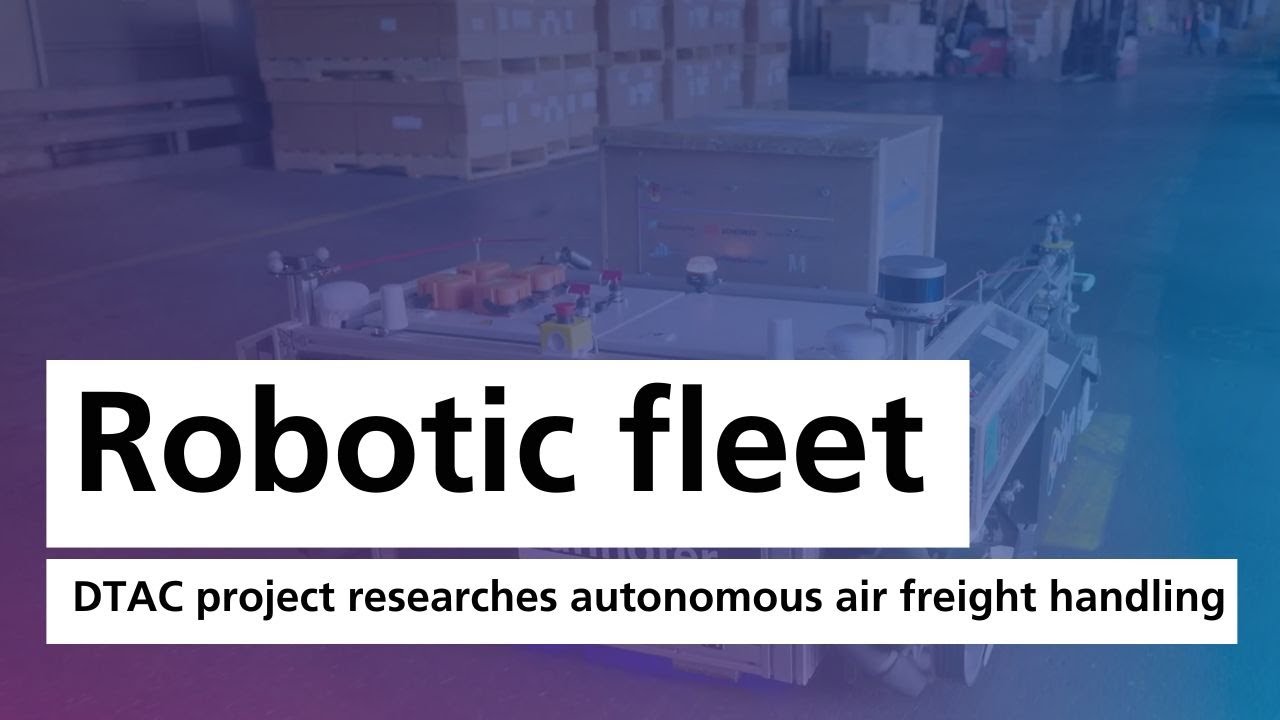
In the Digital Testbed Air Cargo (DTAC) at Munich Airport, the consortium is researching how robotics and autonomous vehicles can make air cargo handling more efficient. The video shows how solutions such as Spot®, automated forklifts, openTCS, O³dyn and evoBOT® work together along the process chain—from inventory to transport and X-ray scanning. The team is currently developing a new end-to-end cargo robot from scratch, and preparing the robot for another round of laboratory and field testing.
Privacy warning
With the click on the play button an external video from www.youtube.com is loaded and started. Your data is possible transferred and stored to third party. Do not start the video if you disagree. Find more about the youtube privacy statement under the following link: https://policies.google.com/privacyBenefit from working with the Fraunhofer IML
- Assess the state of the art: The Fraunhofer IML analyzes the future potential of automation in your given environment.
- Customized concepts: Design of customized robotic systems and implementation support tailored to your specific processes.
- Test robotic prototypes: Flexibly deploy various types of robots.
- Centralized control: Implement integrated control system solutions for all automated and robotic systems.
- Optimizing processes: Whether in airport operations or logistics environments - processes are prepared for the automation of the future.
Further Information
Those seeking a deeper understanding of the DTAC project can find additional technical and subject-matter information in the final reports of the subprojects, the consortium’s progress and annual reports, the test and validation documentation as well as in technical documentation on use cases, interfaces, simulations and demonstrators. In addition, external sources such as the project website, federal funding and project information, IATA documents on “ONE Record” and open-source resources related to NE:ONE® are available.
Discover logistics - Air cargo handling
Press release sustainability price
Press release International Award for Excellence in Air Cargo
Press release Air Cargo Connect 360
Press release evoBOT at Munich airport
Press release project extension
Press release ONE Record Hackathon
Press release International Air Cargo Award
Awards and Recognition
Scientific and other publications
Internationales Verkehrswesen (2024): Integrated robotics tests with 5 solutions
Internationales Verkehrswesen (2025): Guidance System for Robot Fleets at Airports
Logistics Research (2026): O³dyn Tests at Munich Airport
Journal of Air Transport Studies (2025): Human Factors in Airport Automation
Funded by
